AI Tool for SEO Content Writing: How to Use It Without Sacrificing Quality

If you are searching for an AI tool for SEO content writing, you likely want to produce articles that rank without spending hours on every draft. The right tool can help you generate outlines, write paragraphs, and optimize for keywords, but it only works when you integrate it into a disciplined workflow. This guide explains how to use such a tool effectively, what mistakes to avoid, and how to get the most value from AI without sacrificing quality.
What an AI tool for SEO content writing actually does
An AI tool for SEO content writing uses natural language processing to generate text from your input. It can help with blog posts, product descriptions, and landing pages by suggesting headlines, writing sections, or producing full drafts. The key is that it does not replace your judgment: it provides a starting point you refine.
Input a target keyword like "best running shoes" and the tool can generate an outline with suggested H2s and H3s, then write a draft that includes the keyword naturally. It can also help with meta descriptions and title tags. Output quality depends on the brief you provide. Vague instructions produce generic content. A structured SEO content brief for AI is the difference between a usable draft and filler.
How to use an AI tool for SEO content writing: step by step
Follow this method to turn AI from a toy into a productivity booster:
-
Define intent and audience. Before you open the tool, know who you are writing for and what problem you solve. This shapes tone, depth, and examples.
-
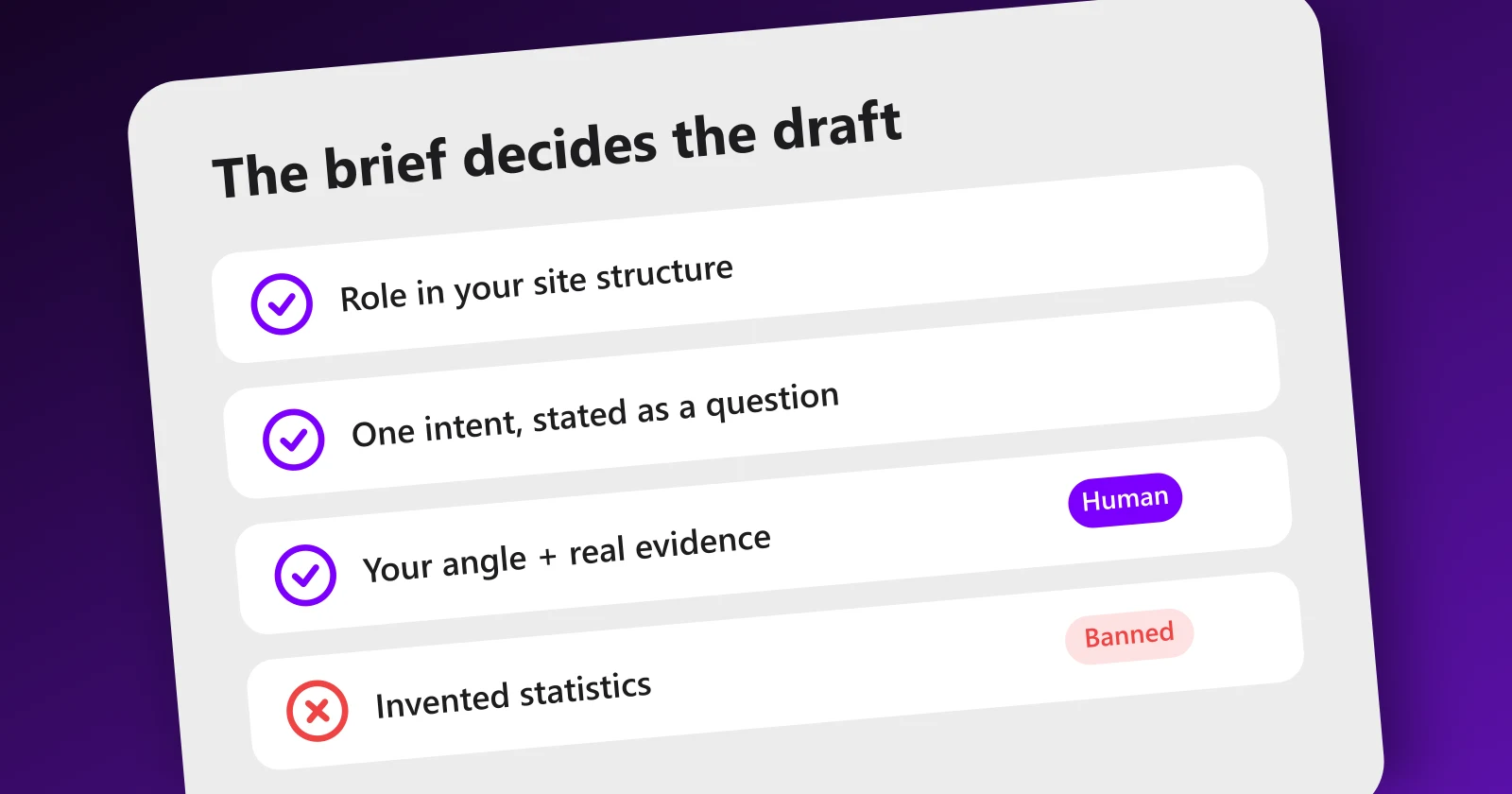
Create a detailed brief. Include the primary keyword, secondary terms, target word count, and specific points to cover. The more context, the better the output.
-
Generate an outline first. Produce a structure with H2s and H3s. Review it for logic and topic coverage before drafting body copy.
-
Draft section by section. Generate each part with clear instructions. Section-by-section drafting gives more control than generating the whole article at once.
-
Edit and fact-check. AI can produce plausible but incorrect information. Verify all claims, especially statistics and technical details. Add your own expertise and examples. How to edit AI drafts walks through the checklist most teams skip.
-
Optimize for on-page SEO. Use the tool to suggest keyword placement, but ensure it reads naturally. Check title tags, meta descriptions, and internal links. Meta tags for SEO covers the elements that still matter in 2026.
-
Review with a human eye. Read the final draft aloud to catch awkward phrasing. Confirm it matches your brand voice and satisfies search intent.
For the full editorial arc from keyword to published page, see how to write an SEO blog post. AI compresses steps 3 to 5; it does not remove steps 1, 6, or 7.
Common mistakes to avoid when using AI for SEO content
Even with a good tool, these pitfalls hurt rankings:
Keyword stuffing. Some tools over-optimize, repeating the keyword unnaturally. That can trigger quality filters. Use the keyword where it fits, not everywhere.
Ignoring user intent. Writing for the wrong intent fails even when the grammar is perfect. If searchers want a comparison list, a single product review will not rank.
Publishing unedited AI output. AI can hallucinate facts or produce bland prose. Always edit and add your own insights. AI content and Google's guidelines are clear: method of production is not the issue; helpfulness and originality are.
Neglecting E-E-A-T. Search engines value experience, expertise, authoritativeness, and trust. AI content lacks personal experience by default, so you must add it: case studies, credentials, and opinions only you can hold. What is E-E-A-T explains how to prove those signals on the page.
Forgetting internal linking. AI will not automatically link to your other pages. Add contextual links to related content. If you mention technical audits, link to how to do a technical SEO audit. If you discuss site architecture, link to internal linking for SEO.
The counterintuitive benefit: AI helps you write more like a human
Using an AI tool for SEO content writing can make your content more human, not less. AI handles repetitive structure and first-pass wording, which frees time for perspective, stories, and examples only you can add. The AI draft is a skeleton; you flesh it out with personality.
Instead of spending an hour on a bland introduction, generate a few options, pick the strongest, then invest your time in a compelling anecdote or a data point you gathered firsthand. AI also helps overcome writer's block: a generated paragraph can spark ideas you would not have reached staring at a blank page.
Treat AI as a collaborator, not a replacement. That mindset aligns with writing for GEO, where originality and cite-worthy answers matter as much as traditional rankings.
How to measure whether it is working
Word count is the wrong metric. Track what actually moves SEO:
- Indexing and impressions in Search Console within weeks of publish
- Average position on target keywords after the page is indexed
- Clicks and engagement (time on page, scroll depth) once impressions appear
- Edit time per article internally: if AI saves hours but every draft still needs a full rewrite, your brief needs work, not a new tool
Operational savings (faster briefs, faster first drafts) show up in month one. Ranking ROI typically needs three to six months after publish, review, and indexing. Judge traffic on that runway, not on day one.
Before you choose a tool
Test any AI writing tool with the same brief and compare:
- How much you had to delete versus keep
- How many factual claims needed verification
- Whether it respected your tone rules without heavy rewriting
- Whether it connects to your CMS or leaves you copy-pasting
A tool that produces prettier first drafts but doubles your fact-checking time is not saving you anything.
To see which pages your site is missing before you scale AI writing, run a free SEO analysis. It returns authority gaps, page opportunities, and the keywords behind them in about two minutes. Writing the right pages matters more than writing more pages faster.
Frequently asked questions
Quick answers to the questions people ask most about this topic.
No. AI can generate drafts and suggest optimizations, but it lacks the judgment, creativity, and real-world experience a human brings. Use it as an assistant to speed up writing, not as the sole author.
Look for customization, workflow integration, and output that matches your brand voice. Test several tools with the same brief and compare edit time required, not just first-draft quality. Price and ease of use matter only after those three.
Google's guidelines focus on content quality, not production method. Helpful, original content that demonstrates E-E-A-T can rank whether a human or AI drafted it. Spammy, low-effort mass content can be penalized regardless of how it was written. Always edit and add value.
Add your own research, case studies, and personal anecdotes. Use AI for structure and first drafts, then rewrite key sections in your voice. Include insights only you can provide: real numbers, client stories, or first-hand experience.
Research and define intent, create a detailed brief, generate an outline, draft section by section, edit and fact-check, optimize on-page elements, then have a human review before publish. Skipping the edit step is the most common reason AI content fails to rank.
Yes. Many tools generate meta titles and descriptions from your draft. Review every suggestion for accuracy and click appeal before publishing. Meta tags affect CTR even when they do not directly change rankings.

I built Meeeters to make link building safe and simple: real, relevant backlinks with no reciprocal footprint and no black-hat shortcuts.