Best AI SEO Tools in 2026 (What Each One Actually Automates)

Search "best AI SEO tool" and you get twenty listicles ranking twenty products against each other as if they did the same job. They do not. One drafts articles, one grades them, one finds keywords, one crawls for broken links, one finds outreach prospects. Comparing them head to head is like comparing a saw to a hammer.
This page compares them by the only thing that matters when you are paying for them: which step of the workflow each one removes from your plate, and which step it hands straight back to you.
What counts as an AI SEO tool
The label covers five distinct categories. Almost every product on the market sits in one of them.
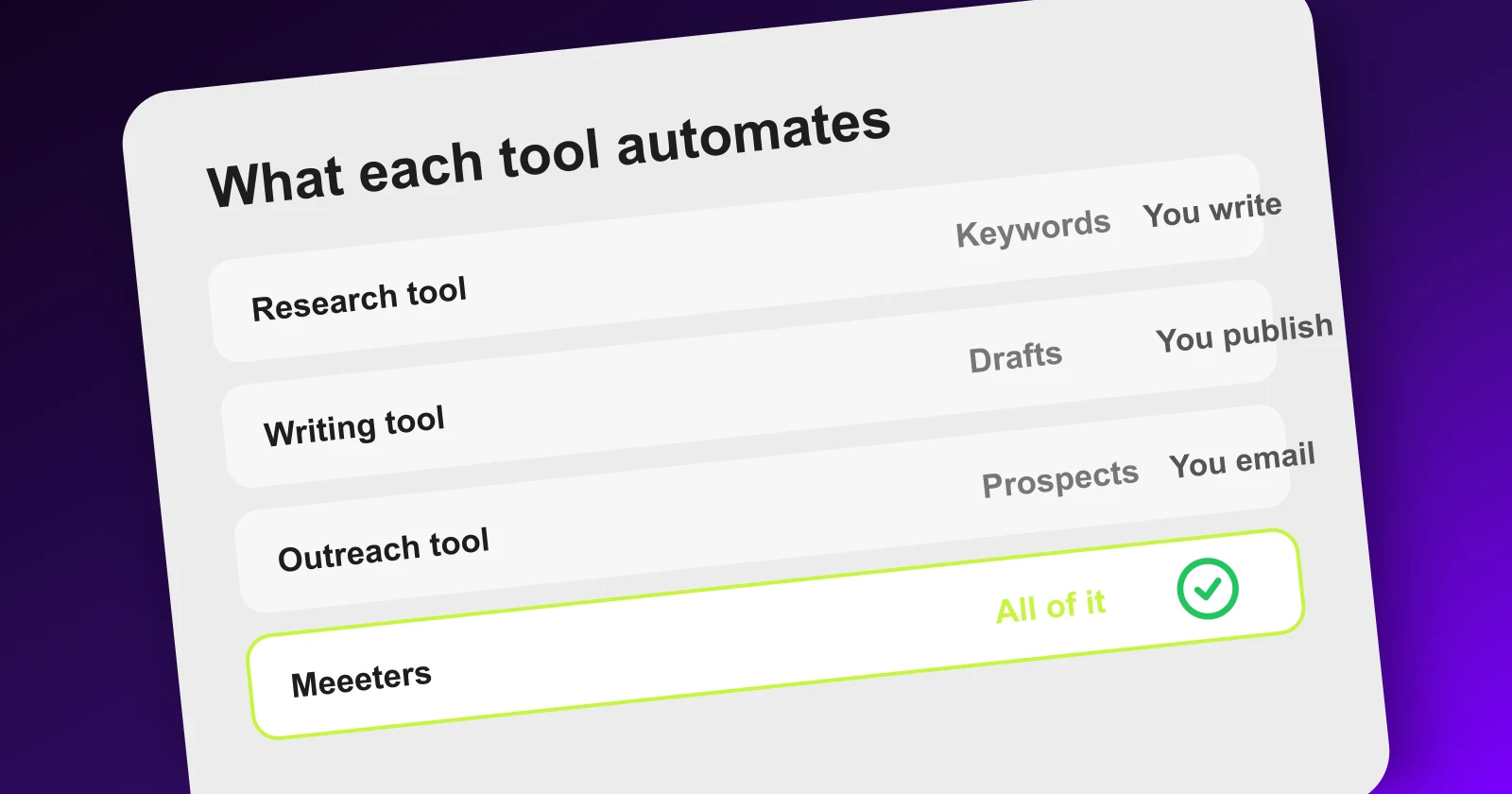
| Category | What it automates | What it hands back to you |
|---|---|---|
| Research | Finds keywords, volumes, difficulty, related terms | A spreadsheet. You still decide what to write and write it. |
| Writing | Drafts the article from a brief or a keyword | A draft. You still edit, format, add links and publish it. |
| Optimization | Grades a draft against the pages already ranking | A score and a to-do list. You still make the edits. |
| Technical | Crawls the site, flags errors, indexing and speed issues | An issue list. You still fix them in the code. |
| Link building | Finds prospects, sometimes drafts the outreach email | A prospect list. You still send, follow up and negotiate. |
Read the right-hand column again. That is the honest summary of the category: most AI SEO tools produce information, not outcomes. The work moves from "figure out what to do" to "do it", which is real progress, but it is not automation of the job.
Why it matters more than the feature list
The reason this distinction matters is cost, and it is not the subscription cost.
A research tool, a writing tool and an outreach tool typically run somewhere around $240 a month combined at list price. That is the visible number. The invisible one is that you are still the person who picks the keyword, writes the brief, edits the draft, formats it in the CMS, hits publish, then goes and asks strangers for links. Four subscriptions later, the bottleneck is still you.
This is why so many teams buy tools, use them for two months, and quietly stop. The tools worked. The workflow did not.
The five categories, and who each fits
Research tools
The established players here are Ahrefs, Semrush and Moz. Their AI layers mostly sit on top of very large crawl indexes, which is the part that is genuinely hard to build and the reason these tools cost what they do.
Fits you if you already know how to act on the data and just need better data. Does not fit if the spreadsheet is where your process stalls.
Writing tools
Jasper, Copy.ai and the general purpose assistants live here. Modern models write competent prose, so quality is no longer the differentiator it was two years ago.
The differentiator now is context. A tool that knows nothing about your site will write a generic article on your keyword. A tool that has crawled your site knows which pages already exist, which means it can avoid repeating them and can link to them properly.
Fits you if you have a content plan and need volume. Does not fit if you do not yet know what to write.
Optimization tools
Surfer, Frase and Clearscope grade a draft against what is already ranking and tell you what is missing.
These are useful and genuinely improve pages. The catch is that they optimize a page you already decided to write. If that decision was wrong, a higher score does not save it.
Fits you if you publish regularly and want each page to compete harder. Does not fit as your only tool.
Technical tools
Screaming Frog, Sitebulb and the crawl modules of the big suites. AI has changed this category least, because crawling and rule checking were always deterministic work.
Worth knowing: a JavaScript-rendered site can look almost empty to a crawler that does not execute JS, which produces alarming reports that are not real problems. Check how the crawler renders before you panic about a one-page result.
Fits you if you have a large or complex site. Does not fit as a growth lever on a small site that is technically fine.
Link building tools
Pitchbox, BuzzStream and Respona find prospects and manage outreach sequences.
This is the category where the gap between "the tool did it" and "you did it" is widest. The tool finds the prospect and drafts the email. You still send it, follow up three times, and accept that most will not answer.
Fits you if you have someone whose job is outreach. Does not fit if nobody has time to run the sequences.
The category that is missing from most lists
Look back at the table. Every category stops at the point where the work starts. That is the gap Meeeters was built for, and it is the whole difference between a tool that helps with SEO and an AI SEO tool in the strict sense: one decides and acts, the other reports.
Instead of automating one step, it runs the chain: it crawls your site to learn what you actually do, picks the keywords worth targeting from that audit, writes the articles, publishes them to your CMS, and gets you dofollow backlinks from scanned, eligible members of your own niche, with no reciprocal link back.
| A tool stack | Meeeters | |
|---|---|---|
| Site audit | Separate crawler | Included, refreshed monthly |
| Keyword selection | You, from a spreadsheet | Picked from your audit |
| Writing | Writing tool, generic context | Written with your site's structure in context |
| Publishing | You, by hand in the CMS | Published to your CMS |
| Internal linking | You | Done, inside the right silo |
| Backlinks | Outreach tool plus your time | Earned through the network |
| Typical monthly cost | Around $240 across three subscriptions | $40, free to start |
The honest caveat: a network of members is not the same thing as a top-tier editorial placement in a national publication. If you need that specific outcome, you need a PR budget, not a tool. What the network does well is steady, relevant, verified links from real sites in your niche, which is what most sites are missing.
How to tell a real workflow from a wrapper
Three questions cut through the marketing on any AI SEO tool:
- What does it know about my site? A tool that has not crawled you cannot avoid duplicating your existing pages or link to them correctly. If onboarding is just "paste a keyword", it knows nothing.
- What do I do after it finishes? If the answer is a long list, the tool moved the work rather than removing it.
- Does it touch anything outside its own dashboard? Publishing to your CMS and placing real links are hard. Producing a report is not. The tools that do the hard part are a different category from the ones that do not.
A fourth, if you are comparing free tiers: ask what the free tier costs the vendor to run. Anything with a real per-use cost, such as live backlink data, will be limited. Anything computed in your browser can be genuinely unlimited and free.
Where to start
If you already have a working process and just need better data, buy a research tool and stop there. That is the correct answer for a lot of teams and no listicle will tell you so.
If your problem is that nothing gets published and no links come in, more data will not fix it. That is a workflow problem, and it is worth looking at tools that cover the whole chain rather than adding a fifth subscription to the pile.
The quickest way to tell which of the two you have is to look at what your site is actually missing. A free analysis gives you your authority score, the pages worth creating and the keywords behind them, in about two minutes. If the list of missing pages is long, your problem is production. If it is short and you still get no traffic, your problem is authority, and no writing tool on this page will solve that one.
Frequently asked questions
Quick answers to the questions people ask most about this topic.
An AI SEO tool uses machine learning to automate part of the search optimization workflow, most often keyword research, content drafting, on-page grading, technical auditing, or link prospecting. The category is broad, so two tools both labelled AI SEO can do completely different jobs.
It depends on which steps you need covered. A single-category tool replaces one task and leaves the rest to you, so it does not replace an agency. A tool that covers audit, content and links end to end gets much closer, which is why the useful comparison is coverage of the workflow rather than raw AI quality.
Free tiers are genuinely useful for one-off checks such as grading a page or estimating a domain's authority. They rarely cover recurring work like publishing on a schedule or acquiring links, because those carry real cost per use for the vendor.
No. Google's guidance targets low value content produced at scale to manipulate rankings, not the method used to produce it. AI-written pages that are accurate, useful and genuinely answer the query are treated like any other page.
Most small teams end up with three or four, typically a research tool, a writing tool and an outreach tool, plus a crawler. That stack is the reason the monthly bill climbs, and it is worth checking whether one tool covers the same ground before adding another.
Ask which step of the workflow you still perform manually after the tool has run. A tool that produces a list of recommendations leaves the execution with you, whereas a tool that publishes a page or places a link has actually removed work.

I built Meeeters to make link building safe and simple: real, relevant backlinks with no reciprocal footprint and no black-hat shortcuts.
Related searches, answered
What people actually type before landing here, with the short answer and where to read more.
- Best SEO automation tools
- Judge them on how many consecutive steps they close, not on the number of features listed on the pricing page.What an AI SEO tool actually is ›
- Best automated SEO tools
- Automation is only safe where a human still approves. Publishing straight to live is where sites get into trouble.Scaled content abuse ›
- Best automated SEO software
- Most suites automate reporting and leave you the decisions. Reporting is the cheapest step to automate, and the least valuable.Automating the report ›
- SEO automation tools
- Start by automating the step that eats your week. For most sites that is producing content, not tracking positions.How much to publish ›
- What should never be automated in SEO?
- Anything a reader would notice: the angle, the facts, the final read. Everything upstream of that is fair game.Where to draw the line ›