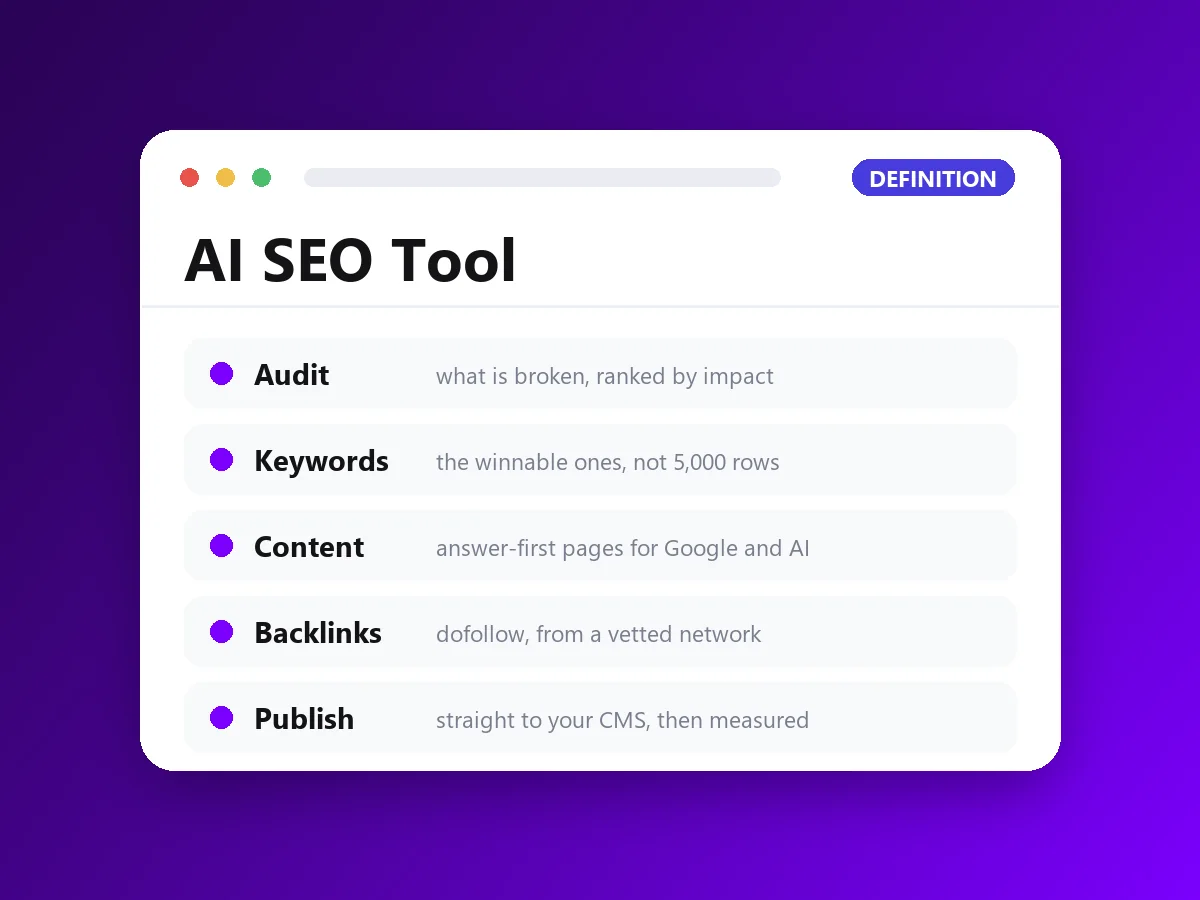
What Is an AI SEO Tool? A Plain Definition (and What They Actually Automate)

The short answer
An AI SEO tool is software that uses artificial intelligence to run part of the search-optimization workflow for you, instead of only reporting on it. It audits a site, chooses keywords, drafts and publishes content, earns or analyzes backlinks, or builds the reports, and it makes the judgment calls a person used to make by hand.
That is the whole definition. Everything below is about which part of the workflow each tool actually covers, because that is where the category gets confusing.
Meeeters is an AI SEO tool that automates SEO and GEO end to end: it audits your site, picks the keywords you can realistically win, drafts answer-first articles for both Google and AI search, publishes them to your CMS for approval, earns dofollow backlinks from a network of vetted sites in your niche, and tracks the visibility you gain in AI assistants.
What separates it from a classic SEO tool
A classic SEO tool measures. It tells you a page has a missing meta description, that a keyword has 2,400 monthly searches, that you lost eleven referring domains last month. The judgment, and all the work, stays with you.
An AI SEO tool decides. It reads the same data and returns an action: this page first, this keyword next, this draft, this site to contact. The measurement is still there, it just stops being the deliverable.
That distinction matters more than the model behind the tool. A product that runs on a large language model but still hands you a 4,000-row export has automated nothing.
The five categories
Nearly every tool sold as "AI SEO" fits one of these. Knowing which one you are looking at tells you what will still be left on your plate.
- Auditors. Crawl the site, find technical and on-page problems, rank them by impact. Good ones tell you what to fix first, which is the hard part. See what a useful audit report looks like for what a thorough pass covers.
- Keyword tools. Expand seeds into keyword sets with volume, difficulty and intent. The AI layer usually means clustering and intent tagging rather than raw data, since the data itself comes from the same handful of providers.
- Content generators. Turn a keyword or brief into a draft. The largest and noisiest category, and the one where the gap between demo and useful output is widest. Editing AI drafts is where most of the real quality is won.
- Link tools. Analyze a backlink profile, find prospects, or draft outreach. Very few actually earn a link; most stop at the spreadsheet.
- Reporting tools. Pull Search Console and analytics into a readable narrative. The easiest step to automate, because the inputs never change.
How to tell a real workflow from a wrapper
Three questions separate them, and none of them are about the model.
How many consecutive steps does it close? A tool that picks the keyword, writes the page and publishes it has closed three. A tool that writes when you paste a keyword has closed one, and you are still the integration layer between tabs.
Where does its data come from? Ask whose index it uses. Most backlink and keyword features resell the same two or three providers, so the differentiator is what the tool does with that data, not the data itself. Our own measurement of 596 sites showed domain rating predicts traffic at a correlation of 0.16, which is a good reminder that a confident number is not the same as a useful one.
What happens after it publishes? A tool that ships a page and never looks at it again has automated production, not SEO. The loop only closes when something reads the results back and decides what to do next.
AI SEO and GEO are not the same job
"AI SEO" gets used for two different things, and conflating them is expensive.
The first is using AI to do classic SEO faster: rank in Google, with software doing the work. The second is generative engine optimization, getting your content quoted inside AI answers from ChatGPT, Perplexity and AI Overviews. They share the retrieval layer, so being crawlable and well-structured helps both, but the second needs things the first never asked for: a direct answer in the opening lines, structured data an engine can parse, and independent sources that mention you.
A tool that only tracks Google positions cannot tell you whether either is working. The 45-day automation case shows what that split looks like on a real site.
The risk nobody prices in
Automation makes it trivial to publish a hundred pages nobody needed. Google's scaled content abuse policy exists for exactly that, and it does not care whether a human or a model wrote the text. What it targets is volume produced primarily to rank.
The protection is procedural, not technical: publish as drafts, approve before they go live, and keep a real reason for every page to exist. Any tool that removes that step is selling you speed at the price of your domain.
Where Meeeters fits
Meeeters closes the whole loop rather than one step of it. It connects to your Search Console, audits the site, builds the keyword shortlist from your own topics, drafts pages written to be quotable by both Google and AI engines, publishes them to your CMS as drafts you approve, and earns dofollow backlinks from members whose sites are scanned and eligible. No reciprocal pairs, no chains, no PBNs.
On the AI side specifically, it reports the visits ChatGPT, Perplexity and Gemini actually send to your pages. Search Console never shows those: they arrive as referrals, not as search clicks, so a site can be gaining ground in AI answers with nothing to show for it in the report most people read. It also checks the two things that decide whether an engine can quote you at all, that your robots.txt is not blocking GPTBot, ClaudeBot or PerplexityBot, and that your llms.txt exists, and it connects Bing to surface the queries behind Copilot and part of ChatGPT search.
Analyze your site with an AI SEO tool
Run the free SEO analysis to see what an AI SEO tool finds on your own site: the technical problems worth fixing, the keywords you can realistically win, and the authority gap between you and the pages ranking above you.
Frequently asked questions
Quick answers to the questions people ask most about this topic.
An AI SEO tool is software that uses artificial intelligence to perform part of the search-optimization workflow: crawling and auditing a site, selecting keywords, drafting and publishing content, finding or earning backlinks, or producing reports. What separates it from a classic SEO tool is that it decides and acts, rather than only measuring and leaving the judgment to you.
Yes. An AI writing tool starts from a keyword you supply and returns text. An AI SEO tool decides which keyword deserves a page in the first place, based on your site, your authority and the competition, then handles what happens after the draft: publishing, internal linking and measurement. A writing tool is one step of the workflow, not the workflow.
Some do. Optimizing to be quoted by ChatGPT, Perplexity or AI Overviews is called generative engine optimization, and it needs different things from classic SEO: content that answers the question directly, clean structure and structured data, and independent sources that mention your brand. It also needs its own measurement, since AI assistants arrive as referral traffic and never appear in Search Console. A tool that only chases Google rankings covers neither the work nor the reporting.
Publishing at volume without editing can. Google's scaled content abuse policy targets mass-produced pages made primarily to rank rather than to help. The risk is not that a page was drafted by AI, it is that nobody checked it before it went live. Tools that publish as drafts for approval keep a human in the loop by design.
Point tools start around 20 to 50 USD a month for one job, such as writing or rank tracking. Full suites run from 100 USD a month upward. The number that matters is not the sticker price but how many separate subscriptions you need to cover the whole workflow.

I built Meeeters to make link building safe and simple: real, relevant backlinks with no reciprocal footprint and no black-hat shortcuts.