What 45 Days of SEO Automation Actually Looks Like (With the Case That Went Down)

If you spend any time in SEO communities, you already know the verdict on tools like ours. The threads are not subtle: automation gets called a grift, AI SEO gets called snake oil, and the sharpest version of the criticism is the one worth repeating.
You should never automate judgment.
That one is correct, and this article is what happens when you take it seriously. Here is what our own pipeline does, what it refuses to do, and what forty-five days of it actually produces.
What we automate, and what we refuse to
Three decisions stay with the member, always.
Which keywords you target. A tool ranks keywords by volume and difficulty because those are the two things it can measure. It cannot measure whether you can credibly serve the person behind the query. Meeeters proposes a shortlist and you approve it, because a wrong keyword commits months of writing before anyone notices.
What you claim about your business. The generation step is forbidden from inventing a number, a price, a date, a source or a case study. Not discouraged, forbidden, and checked before a draft reaches you. A page that reads beautifully and misstates your refund policy is worse than no page.
What goes live. Drafts land in your CMS as drafts. Auto-publish exists, it is off by default, and turning it on is a deliberate act.
Everything upstream of those three is automated, because it is information work rather than judgment: crawling, indexing checks, keyword shortlisting, silo planning, briefs, first drafts, internal linking, backlink matching, and link verification. What should never be automated in SEO sets out that line in full.
The 45-day sequence, in the order it actually happens
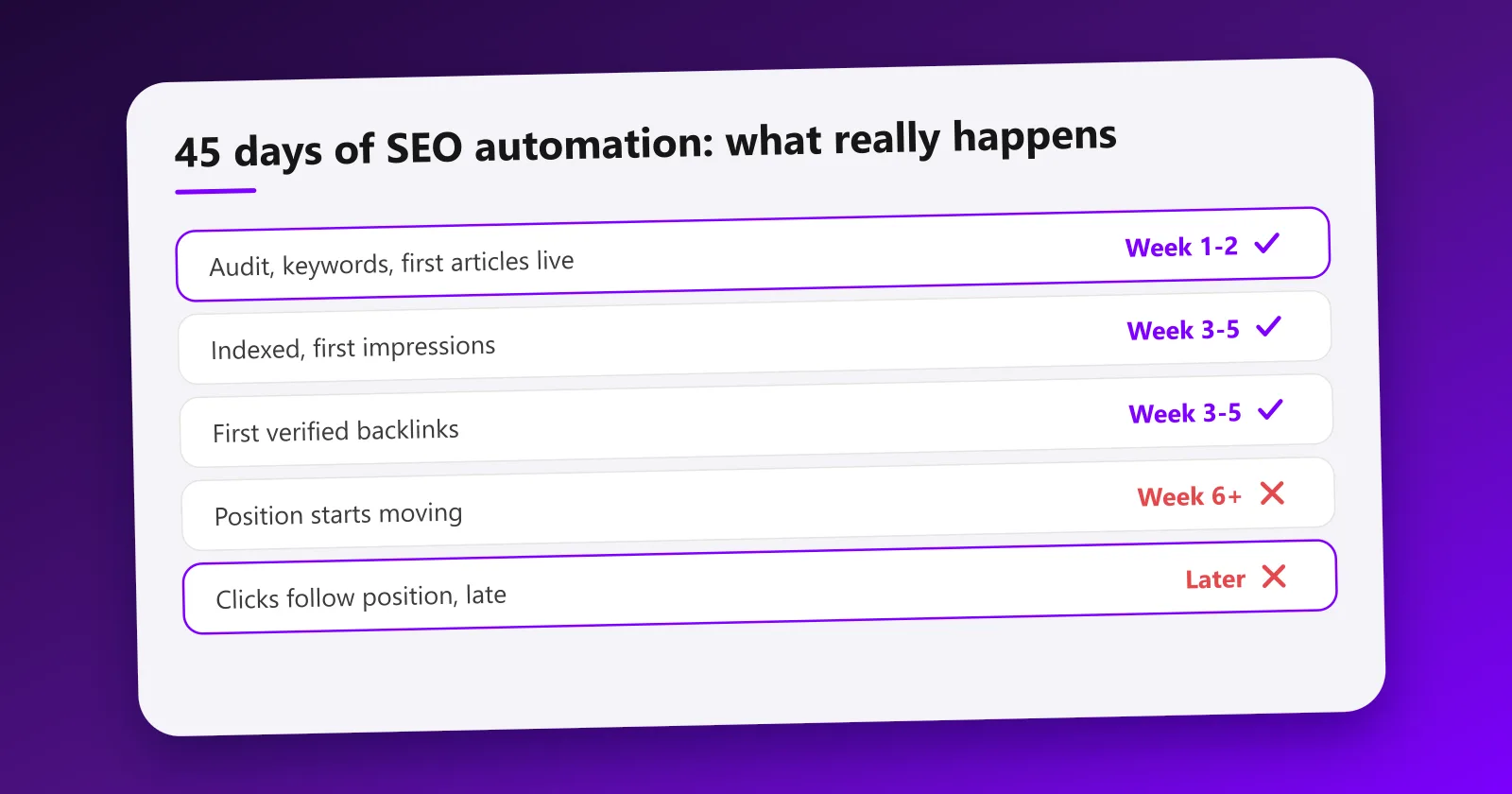
Weeks 1 to 2. The machine gets built. The audit runs, the keyword shortlist comes back, the silo plan is set, and the first articles are written and published. This is the fast part, and it is the part that feels like progress.
Weeks 3 to 5. Indexing and first impressions. Your new pages start appearing for queries, usually at positions nobody clicks. Your first verified backlinks land, because a link has to be published, found and checked before it counts.
Week 6 and beyond. Position, then clicks. Movement starts on the narrow queries first. Clicks follow position, not the other way round, and they follow it late.
That last point is where most disappointment comes from. Impressions only require your page to appear somewhere, including position 60. Clicks require a position people actually see. So the impression curve climbs early while the click curve stays flat, which looks like failure and is simply the normal order of events.
Our own numbers, including the one that went down
Most articles like this show a graph going up. Here are four, and one of them goes down.
Every case study below is generated from the member's own Search Console, unedited, published with their written consent, and removable by them at any time. They are public, and they refresh as the underlying data moves, so these are the figures they showed on 5 August 2026.
oakflowai.com, a process automation agency. Around 4.1K impressions a month, up from 3.9K, 79 organic clicks, average position 12.3. The longer curve is the interesting part: 44 impressions in October, then 178, 348, 536, 591, 897, then into the thousands in spring. That is what compounding looks like, and it took a lot longer than 45 days.
ferrstudio.ch, a design studio. Around 72.5K impressions a month, up from 61.6K, 1031 clicks, average position 8.9. Full disclosure: this is the founder's own agency site and it had traffic before Meeeters existed. Treat it as evidence the pipeline runs at volume, not as proof it created that audience.
meeeters.com, this product. 0 to 21K impressions in two months. 41 clicks. Average position 79.2. We publish that rather than hide it, because it is the honest illustration of the gap: impressions arrive fast, clicks do not. Position 79 means indexed and mostly invisible. Anyone selling results in 45 days is describing that impressions column and hoping you do not read the other two.
bereach.ai. Around 13.4K impressions a month, down from 13.9K. Clicks down too. It is published under that title on our own site, because a case study that only ever goes up is not evidence, it is selection.
So what does 45 days actually buy you
A working machine and a measurable baseline. The audit done, the keywords chosen, the silos planned, the articles published and indexed, the first verified links earned.
Not the traffic. The traffic comes later, and how much later depends on your competition, your existing authority and how narrow your queries are.
That is a less exciting promise than the one you will read elsewhere. It has one advantage: you can check it against our own numbers, which are public and which we do not edit.
Who this is not for
If your content is weak, automation makes more weak content faster. It multiplies whatever process you feed it: a clean process scales results, a messy one scales mistakes at the same speed and leaves a footprint that takes months to clean. Scaled content abuse is what that looks like when it goes wrong.
If you want guaranteed rankings, no honest tool can sell you that.
And if you already rank well with a team doing this properly, you do not need us.
Where it does fit
Sites with something real to say and nobody to say it consistently. Founders who know what to write and never write it. Teams whose technical SEO is fine and whose problem is that nothing ships.
That is the actual constraint for most small sites. Not knowledge. Execution.
Meeeters starts with a 3-day trial: the audit, SEO and GEO articles, and verified backlinks. Run the free SEO analysis and see the baseline on your own site before you decide anything.
Frequently asked questions
Quick answers to the questions people ask most about this topic.
Longer than 45 days, and the sequence matters more than the total. Publishing and indexing are fast, impressions follow within weeks, position moves after that, and clicks follow position last. On narrow queries you can see movement in two months. On competitive ones held by established sites, expect considerably longer. The part automation genuinely compresses is production, not Google's evaluation.
A completed audit, a keyword shortlist you approved, a silo plan, articles published to your CMS, your pages indexed, first impressions appearing in Search Console, and your first verified backlinks. That is a working machine and a measurable baseline. It is not a traffic result, and treating it as one is how people conclude too early that SEO does not work.
Because impressions only require your page to appear somewhere in the results, including position 60, where nobody clicks. Clicks require a position people actually see. So a new site's impression curve climbs early and its click curve stays flat, which looks like failure and is simply the normal order of events.
It happens, and pretending otherwise is why so much of this category is distrusted. Rankings move for reasons nobody controls: algorithm updates, competitors publishing, seasonality, or a query mix shifting. One of our own public case studies shows a member whose monthly impressions fell rather than rose. We publish it because a case study that only ever goes up is not evidence, it is selection.
It does not choose your keywords for you, it does not verify claims about your business, and it does not decide what goes live. Those three stay with a person, because each one requires knowing something the tool cannot know. Everything upstream, from crawling to briefs to first drafts, automates safely.

I built Meeeters to make link building safe and simple: real, relevant backlinks with no reciprocal footprint and no black-hat shortcuts.