What Should Never Be Automated in SEO (and What Safely Can)

Short answer: automate everything that collects information. Never automate the decisions that information is supposed to inform.
That line is more useful than the usual list of tasks, because it survives the next tool release. Ask any SEO practitioner where they draw it and the answer converges on the same word: judgment. You can automate the analysis, the reporting, the crawling and even the first draft. What you cannot hand over is the moment where someone decides what any of it means for this specific business.
The line is judgment, not task size
The common way to sort this question is by task: content bad, technical fine, links impossible. That framing breaks immediately, because content briefs automate beautifully and technical fixes can be catastrophic when applied blindly.
The better sort is by what the task actually produces.
Information tasks narrow your options. A crawl tells you which pages return errors. A rank tracker tells you where you stand. A draft gives you something to react to. If the output is wrong, you notice, and nothing has happened yet.
Decision tasks commit you. Choosing a keyword commits months of writing. Publishing commits your reputation. If the output is wrong, the cost lands on your domain and stays there.
Automate the first category without hesitation. Guard the second.
The three decisions to keep
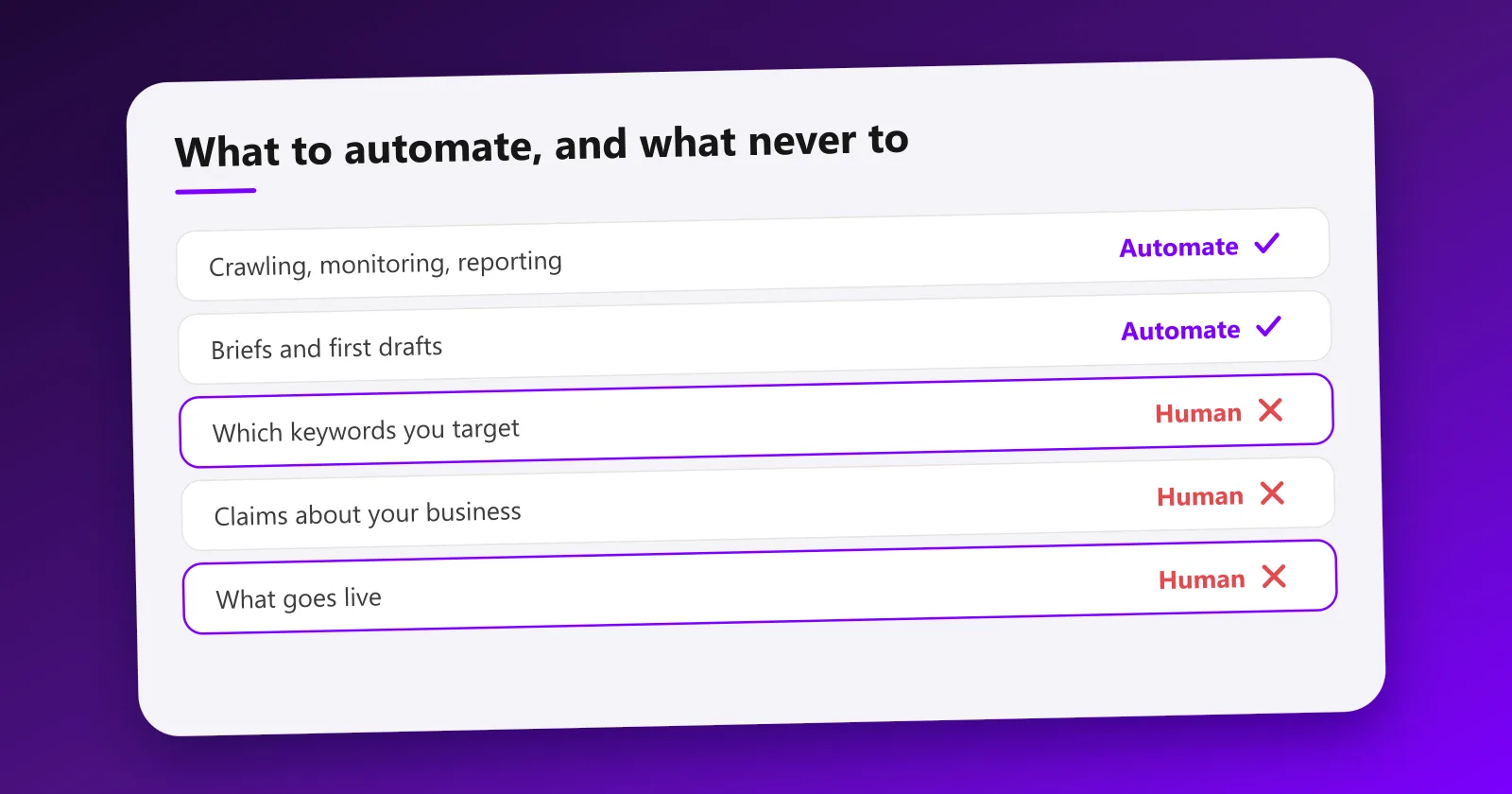
1. Which keywords you target
This is the one practitioners name first, and it is the one most tools quietly take from you. A keyword tool ranks by volume and difficulty because those are the two things it can measure. It cannot measure whether you can credibly serve the person behind the query.
A tool will happily hand you a high-volume term that your business has no right to rank for, and you will not find out for six months. Worse, it will hand you a term that you can rank for and that brings you visitors who will never buy, which is a slower and more expensive failure because the traffic graph looks like success.
Narrowing the list is automatable. Picking from the list is not. If you want the mechanics of doing this deliberately, keyword strategy covers the selection step itself.
2. What you claim about your own business
A model can write a fluent paragraph about your pricing, your guarantees, your certifications and your client results. It has no way to know whether any of it is true.
This is the failure mode that costs the most and gets discussed the least, because it does not look like an SEO problem. It looks like a page that reads well and quietly misstates your refund policy. The fix is structural rather than editorial: never let a generation step invent a number, a date, a source or a case study. If a figure is not in your own documentation, it does not go in the article, and no placeholder survives to publication either.
3. What goes live
Review is the last gate, and it is the one people remove first because it is the one that costs time every single day.
Removing it is what separates automation from scaled content abuse. The distinction Google draws is not about how a page was produced, it is about whether the page deserves to exist. A human who reads the draft and can answer "why does this page exist" is the entire difference. How to edit AI drafts is the practical version of that gate, and scaled content abuse is what happens without it.
Everything you can automate today, safely
The list is longer than the cautious version of this article usually admits:
- technical crawling, error detection and monitoring
- indexing and rank tracking
- Search Console and analytics reporting, including the weekly pull nobody enjoys doing by hand
- prioritization: what to fix first, which pages are decaying, which are cannibalizing each other
- internal link suggestions based on your existing published pages
- content briefs, including the structure and the questions to answer
- first drafts
- backlink discovery and relevance checks
Notice what these have in common. Every one of them ends with a human looking at a shorter list than they started with. That is what good automation does. It does not make the decision, it makes the decision cheaper to make.
If you want the landscape by tool category rather than by principle, Meeeters' SEO automation workflow shows where each one stops.
Automation is a multiplier, which cuts both ways
The most useful way to think about this: automation does not create quality, it scales whatever quality you already have.
Run a clean process through automation and you get more of a good thing, faster. Run a messy one and you get mistakes at machine speed, distributed across two hundred pages, with a footprint that takes months to clean up. The tool is indifferent. It amplifies the process you gave it.
This is why "should I automate my SEO" is the wrong question and "is my process good enough to be worth multiplying" is the right one. Most sites that get burned by automation had a broken process first and simply could not see it at ten pages.
Why fully automated SEO keeps failing
Two specific reasons, and neither is about writing quality.
The first is that language models simulate reasoning rather than perform it. That is genuinely useful for producing structure and covering a topic completely. It is not useful for deciding whether a claim is defensible, because the model has no stake in being wrong.
The second is that generic inputs produce generic outputs. Given a topic and no constraints, a model returns the average of everything ever written about it. The average never ranks, because the average is exactly what already exists. What makes a page rank is the part only you know: the constraint you hit, the thing that failed, the reason your advice differs from the consensus. No pipeline generates that, because it is not in the training data. It is in your head.
The practical test
Take any page on your site and ask why it exists.
If you can answer in one sentence that mentions a specific reader and a specific reason, a human decided. If the honest answer is "the tool suggested the keyword", automation crossed the line, and it crossed it at the most expensive point in the chain.
That test also tells you where to spend the time automation frees up. Not on producing more pages. On the three decisions above, which is where results actually come from.
This is exactly how the Meeeters pipeline is built: the scan, the keyword shortlist, the briefs, the drafts and the publishing are automated, and the three decisions stay yours. You approve the keywords, you read the draft, you press publish. Run the free SEO analysis and see what the automated half finds on your site.
Frequently asked questions
Quick answers to the questions people ask most about this topic.
Three decisions: choosing which keywords you target, stating facts and claims about your own business, and approving what gets published. Everything else, including crawling, prioritization, reporting and first drafts, can be automated safely. The common thread is that these three require knowing something the tool cannot know, namely your market, your actual capabilities and your reputation.
No, and the failure is specific rather than general. Tools can gather every signal and even write a competent draft, but they cannot tell whether a keyword matches what your business actually does, and they cannot verify a claim about your product. A fully automated pipeline produces plausible pages that quietly misrepresent the business they promote.
Technical crawling and monitoring, rank and indexing tracking, log and Search Console reporting, internal link suggestions, content briefs, first drafts, and prioritization of what to fix first. These are all information tasks: they narrow your options rather than choose for you.
Automated content is not penalized for being automated. It is penalized when it is scaled without review, adds nothing, and exists only to occupy a keyword. The difference is whether a human read it and can defend why it exists. See scaled content abuse for where the line sits.
Because it runs on a conversation. Finding candidates and checking their relevance is automatable, but the exchange itself involves negotiation, judgment about who you want to be associated with, and a reply from someone who has their own agenda. The discovery half automates well, the human half does not.

I built Meeeters to make link building safe and simple: real, relevant backlinks with no reciprocal footprint and no black-hat shortcuts.