How to Write an SEO Blog Post That Ranks in the Top 10 (Step by Step)

Most advice on writing SEO blog posts stops at "write helpful content and use your keyword". That is true and useless, because it never tells you which keyword, in what format, or what to do after you hit publish.
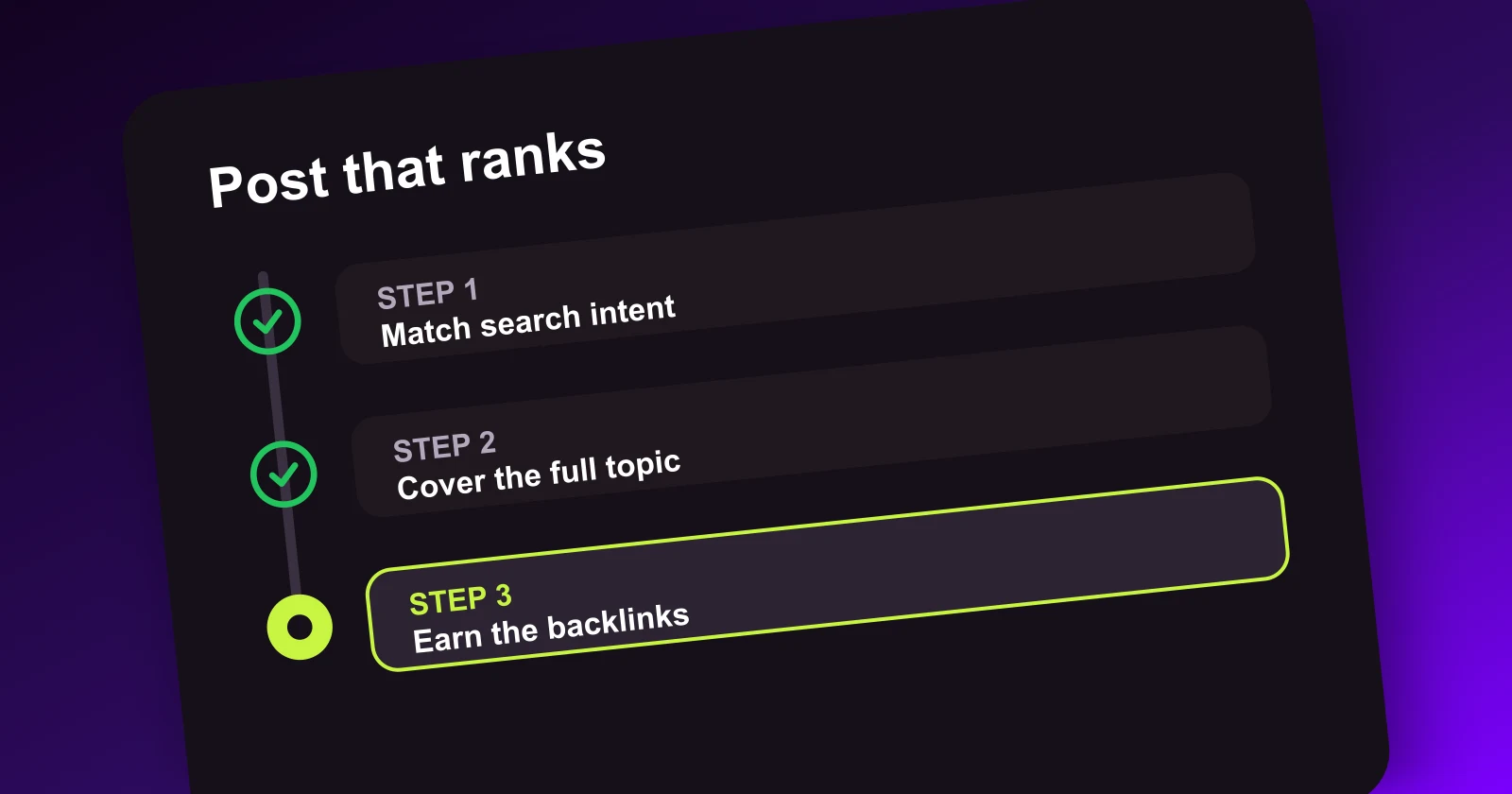
This is the full process instead, ordered the way ranking actually works: pick a winnable keyword, match intent, build the page, then close the authority gap. Work down it in order. A great post on a keyword you cannot win still loses, and the best keyword in the wrong format never ranks.
Start with the target, not the draft
1. Pick a keyword you can actually win
Writing for a keyword ten times your authority is the most common wasted-content mistake. You want keywords where the current top 10 is beatable, not the highest-volume term you can think of.
Do this: run a free SEO analysis of your site. Meeeters returns your site strength (your real domain authority as a simple gauge) and a list of quick wins, so you target keywords in reach instead of ones you will never crack. Background in the keyword research guide.
2. Match search intent before you write a word
Type your keyword into Google and read the top 10 as data. Listicle, step-by-step guide, comparison, tool or product page? That format is the intent Google has already validated.
Do this: note the dominant format in the top 5 and match it. If everyone ranks a how-to guide and you publish an opinion essay, you have lost before you start. This single check saves more wasted posts than anything else here.
3. Map the post to a real gap on your site
The fastest content wins are the pages your topic clearly needs and you have not written yet, not another angle on a page you already rank.
Do this: in the Meeeters dashboard, open Improve my site. The audit lists the highest-priority pages to create, each with a plain reason why it matters for your topic. Write those, so every post fills a gap instead of competing with itself.
Build the page around the answer
4. Answer the query in the first 100 words
State the direct answer immediately, then expand. Readers reward it, Google rewards it, and AI answer engines can only quote a page that resolves the question fast.
Do this: put a one or two sentence answer right under your H1, before any preamble. Burying the answer under 400 words of throat-clearing is the most common self-inflicted ranking wound.
5. Cover the whole topic, not just your keyword
Google ranks the page that most completely satisfies the query. Thin posts that only repeat the keyword lose to pages that answer the follow-up questions too.
Do this: scrape the "People also ask" box and the related searches for your keyword, and make sure every one of those questions is answered somewhere on the page. Completeness beats length every time.
6. Structure with a scannable H2/H3 outline
A clear heading structure helps readers skim and helps Google understand your subtopics. It is also what gets pulled into featured snippets and AI answers.
Do this: write your headings first as a skeleton, one clear subtopic each, phrased the way people search. Fill in the body only once the outline covers the full question.
7. Write self-contained statements under each heading
A sentence that only makes sense after three paragraphs of setup cannot be quoted. Standalone, factual sentences win snippets and AI citations.
Do this: open each section with a plain, complete claim that would make sense lifted out of context, then support it. More on this in how to rank in AI search.
8. Nail the title tag and meta description
The title tag is still one of the strongest on-page signals, and the meta description drives click-through rate even though it is not a ranking factor.
Do this: keep the title under 60 characters with the keyword near the front and a reason to click. Write a ~150 character description that states the promise of the page. The full pass is in the on-page SEO checklist.
9. Add original data, images or examples
Pages that show something no one else has, a chart, a screenshot, a real number, are the ones that earn links and trust. Recycled text does neither.
Do this: include at least one original asset per post: your own data, a labeled screenshot, a process diagram. This is also what makes a post worth linking to, covered in document with original content.
10. Compress and label your images
Heavy images slow the page, and unlabeled images tell Google nothing. Both cost you.
Do this: export images to WebP, keep them under ~150KB where you can, and write descriptive alt text and file names. Speed is a light ranking signal and a heavy conversion one, see the site speed guide.
Connect it to the rest of your site
11. Link the new post into its cluster
A post nothing links to is a post Google may barely crawl. Internal links pass authority and tell Google where the page belongs.
Do this: link the new post from your pillar page and from 2 to 4 related articles, using descriptive anchors. Full method in the internal linking guide.
12. Confirm the page is indexable
Plenty of good posts never rank for one boring reason: Google will not index them.
Do this: check the post is not blocked in robots.txt, carries no stray noindex, and has a clean canonical, then request indexing in Google Search Console. If a page is missing entirely, start with why a site is not showing on Google.
Close the authority gap
On-page work decides whether a post can reach the top 10. On competitive keywords, backlinks decide whether it does. This is the step most writing guides skip, and it is usually the real bottleneck.
13. Fix the page before you build a single link
Links multiply what is already there. A clean, intent-matched post turns every backlink into movement; a broken one wastes them.
Do this: only start link building on a post that passes steps 1 to 12. That is why authority comes last, not first.
14. Earn relevant editorial links without a footprint
The top 10 for competitive terms is usually gated by links, and the two common shortcuts, buying links and direct swaps, both leave patterns Google reads in seconds.
Do this: use a non-reciprocal network. Meeeters is an AI-powered SEO tool that finds you dofollow backlinks in your niche, from network members that are scanned and eligible, so there is no A to B and B to A pair to flag, and every link sits in real editorial content on a site with real traffic. Mechanics in how Meeeters works and why it is safe.
15. Refresh the post before it decays
Rankings decay as fresher results appear. A post that reached the top 10 will slip if you never touch it again.
Do this: every few months, compare the last 6 months to the previous period in Search Console, and update the posts losing the most clicks. Meeeters can generate the updated draft and publish it straight to your CMS. Details in how to update old content.
Why this matters
A blog post that never reaches page one is not cheap content, it is a total loss: the hours to write it, the topic you can no longer target cleanly, and the authority you spread thin across pages that compete with each other. The difference between a post that ranks and one that disappears is rarely writing quality. It is whether you picked a winnable keyword, matched intent, and earned the links to back it. Get the order right and the same effort produces results instead of an archive.
Meeeters vs the usual stack
Most people write SEO posts with a keyword tool (Semrush, Ahrefs) that shows volume and difficulty but not whether your site can win the term, then hope for links later. You end up targeting keywords out of reach and publishing pages that never rank. Meeeters starts from your actual site strength, tells you which pages to write and in what order, drafts and publishes them, and then closes the one gap a keyword tool cannot: real editorial backlinks through a network instead of a marketplace of footprints. It is honest about where you stand before you spend a day writing.
Write posts that reach the top 10
Start where step 1 said: analyze your site for winnable keywords so you write the pages you can actually rank, not another post that gets buried. Then work down this list, and when links become the bottleneck, earn them through the network instead of buying your way into a penalty.
Frequently asked questions
Quick answers to the questions people ask most about this topic.
Long enough to fully answer the query and no longer. Look at the top 10 results for your keyword and match their depth, not an arbitrary word count. A tight 1,200-word post that answers the question beats a padded 3,000-word one that buries it.
On-page factors can move a post in days to a few weeks. Reaching the top 10 on a competitive keyword usually takes 3 to 6 months and almost always needs backlinks. Anything promising the top 10 in a week is selling you a penalty.
Search intent. If your format does not match what already ranks, no amount of writing, keywords or links will fix it. Match intent first, then worry about depth and authority.
On low-competition keywords, strong on-page work is often enough. On competitive keywords, backlinks usually decide whether a good page reaches the top 10. Write the page first so every link you earn actually moves it.

I built Meeeters to make link building safe and simple: real, relevant backlinks with no reciprocal footprint and no black-hat shortcuts.